Table of Contents
It started with a number that didn’t make sense.
We were checking Google Search Console like we do every week. Nothing fancy. Just a quick scroll through queries and clicks.
Then we saw it.
The first sign of a WordPress gambling spam hack on our own site. Our #1 query wasn’t a keyword we’d ever written about.
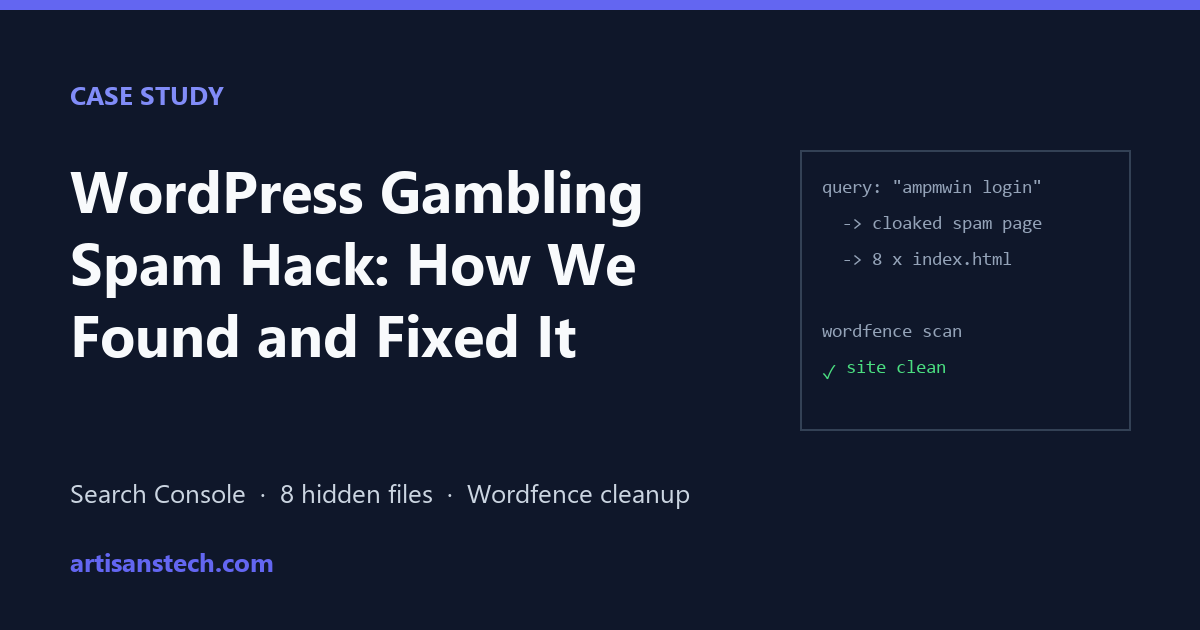
It said: “ampmwin login.”
Not “Laravel tutorial.” Not “WordPress plugin.” Not anything close to our content.
Our stomachs dropped a little.
The First Red Flag
We run a tech blog. We write about Laravel, PHP, AI, Ubuntu, and WordPress. Gambling isn’t exactly our niche.
So why was a gambling-related term suddenly outranking everything else?
We clicked into the query.
The page ranking for it was one of ours. Except it wasn’t, really.
What We Found on the Page
We opened the URL Google was showing.
The page title read something like:
“AMPMWIN Inovasi AI dalam Game…”
We stared at it for a second, confused.
That title had nothing to do with any post we’d written. The meta description was written in Indonesian. It mentioned online games. It didn’t match our branding, our tone, or our content at all.
But somehow, it was live on our domain.
Somehow, Google had indexed it.
And somehow, it was pulling in impressions fast.
Understanding the WordPress Gambling Spam Hack
If you’ve never run into this before, here’s the short version of what was happening.
This is called cloaked spam injection.
In plain language: hackers had planted hidden pages on our site. These pages were built specifically to rank for gambling keywords, mostly targeting Indonesian search traffic around online slots and betting platforms (commonly known as “judi slot” spam).
Here’s the tricky part.
These pages don’t always show up when you visit the URL in a browser.
They’re “cloaked.” That means the hacker’s script checks who’s requesting the page. If it looks like Googlebot, it shows the spam content. If it looks like a regular human visitor, it might redirect you somewhere else, or just show a blank page, or quietly show your normal site.
That’s exactly why we didn’t catch it just by browsing our own blog.
Everything looked fine on the surface.
But underneath, something else was running.
Finding the WordPress Gambling Spam Hack Files
At this point, we weren’t going to guess anymore.
We installed Wordfence and ran a full site scan.
We watched the progress bar. Slowly. File by file.
Then the results came in.
8 malicious index.html files.
Scattered across different folders. Files we never created. Files that had no business being there.
Each one was a tiny doorway. A page designed to rank, redirect, or serve spam content, completely separate from our actual WordPress posts and pages.
Seeing that number, 8, sitting there in red, made it real.
Our site had been compromised. Not in some dramatic, obvious way. Quietly. In the background. While we kept publishing tutorials like nothing was wrong.
Why This Matters More Than You Think
A lot of site owners assume a hack means their homepage gets defaced, or their site goes down, or something loud and obvious happens.
This kind of attack is the opposite.
It’s silent by design.
The hackers don’t want you to notice. They want Google to notice. They want search traffic. They want their gambling pages ranking on a domain that already has trust and authority, like ours.
Every day we didn’t catch it, those pages kept getting indexed. Kept pulling impressions. Kept quietly damaging whatever SEO trust we’d built.
That’s the real danger of a WordPress gambling spam hack like this one. It doesn’t just hurt your site. It hijacks your reputation to promote something you’d never actually associate with.
How We Cleaned Up the WordPress Gambling Spam Hack
Once we had the full picture, we didn’t waste time.
We deleted all 8 malicious index.html files, one by one, double-checking each folder afterward to make sure nothing was left behind.
We ran a second Wordfence scan. Then a third. Clean, both times.
We changed every password tied to the site. WordPress admin, hosting panel, FTP, database. All of it. We also regenerated the WordPress security keys and salts, which logs out every existing session, including any the attacker still had.
We also went back through our installed plugins and themes. Anything outdated or unused got removed. Anything we kept, we updated immediately.
Then we checked Search Console again over the following days.
The “ampmwin login” query slowly dropped out of our top results. The fake pages disappeared from the index. Our real content started climbing back to where it belonged.
The Lesson We Took Away
Here’s the thing about a WordPress gambling spam hack like this one. It rarely announces itself.
There’s no big red banner. No obvious crash. No angry email from a customer.
Just a quiet little anomaly sitting in your analytics, waiting for someone to notice it.
If we hadn’t been in the habit of checking Search Console regularly, this could have run for months. Those 8 files could have multiplied. The spam pages could have kept ranking, kept damaging our domain’s trust, kept associating our name with content we had nothing to do with.
So if you run a WordPress site and want to avoid your own wordpress gambling spam hack story, here’s what we’d tell you now, after going through this ourselves.
- Check Search Console for unfamiliar queries, not just traffic numbers
- Run a malware scanner like Wordfence on a regular schedule, not just when something feels off
- Keep every plugin and theme updated, and remove the ones you don’t actually use
- Change your passwords more often than feels necessary
- Take unusual spikes in impressions seriously, even if they seem harmless at first
- Check the Security issues report in Search Console; Google flags hacked content there (how the report works)
- Follow the official WordPress hardening guide for file permissions and admin access
A WordPress judi slot hack like ours is built to hide in plain sight. The only real defense is paying attention before it has time to spread.
We got lucky that we caught it early. Not every site does.
FAQ: WordPress Gambling Spam Hack
How do I know if my site has a WordPress gambling spam hack?
Look in Google Search Console’s Performance report for queries that have nothing to do with your content, especially gambling terms like “slot”, “judi”, “togel” or casino brand names. A site search such as site:yourdomain.com slot in Google can also reveal pages you never created.
Why can’t I see the spam pages when I visit them?
Because they’re cloaked. The injected code shows spam to search engine crawlers and a normal page, a redirect or nothing at all to regular visitors. Use Search Console’s URL Inspection tool to see the page the way Googlebot sees it.
Will Google penalize my site after a WordPress gambling spam hack?
It can, if the spam stays up. Pages that break Google’s spam policies can drag down trust in the whole domain. Clean the files quickly, fix whatever let the attacker in, and if Search Console shows a security issue, request a review once the site is clean.
For more WordPress and security guides, browse our security articles.